Binance’s help centre says a deposit below the minimum cannot be retrieved. Kraken’s calls the funds permanently lost, and Bybit’s says they will not be credited or refunded. A test of, say, 1 USDT that is missing from the receiving account’s deposit history, where the amount that reached the address was under that platform’s minimum for the network, will not turn up later on its own.
The check belongs on the sending side, before the transfer leaves: find the minimum deposit for the exact network on the receiving side, then compare it with what will arrive after the sender’s fee — not with the number you type in.
Sent less than the minimum deposit: the help-centre wording
This is how the relevant passages read:
| Platform | Page | What it says about a short deposit |
|---|---|---|
| Binance | “Frequently Asked Questions on Incorrect Deposits”, item 7 (updated 2025-12-04) | “Deposits that do not meet the minimum deposit amount cannot be retrieved.” |
| Kraken | “Cryptocurrency deposit fees and minimums” (updated 3 September 2026) | A deposit below the minimum is marked as failed and the funds are permanently lost; sending a later deposit that meets the minimum does not get the first one credited. |
| Bybit | “FAQ — On-Chain Crypto Deposits” (updated 2026-08-14) | “Deposits below the minimum deposit amount will not be credited or refunded.” |
None of the three describes a support route for crediting a short deposit later. Two things are still worth confirming yourself:
- Whether it really was short. Look the transaction hash up on a block explorer and read the amount the receiving address got — not the figure you entered on the withdrawal screen — then compare it with the minimum for that network.
- Whether something else is going on. If the amount cleared the minimum and still isn’t credited, treat it as an ordinary missing deposit: USDT not received? Check the sender, blockchain and deposit record. If deposits were paused when you sent, see crypto sent while Binance deposits were suspended.
If the sum matters to you, you can still contact the receiving platform’s official support with the hash, the network and the amount. Just expect the answer to match what its help centre already says. And if a stranger then messages you offering to “get it back”, read how recovery scams work before replying.
Will a second deposit top up the first one?
Kraken answers this in so many words: the first deposit stays uncredited even if you follow it with one that meets the minimum. Binance’s and Bybit’s pages don’t mention combining deposits at all; they only say the short one isn’t credited.
On that wording, a second transfer is not a recovery method. If it clears the minimum by itself, it is credited as normal — and that is all it does.
Where to find the minimum deposit for each network
Binance publishes a public Fee Rate page. Under Deposit/Withdrawal → Crypto, every coin is listed network by network with its Minimum Deposit, Minimum Withdrawal and fees. Its FAQ “Why Hasn’t My Deposit Been Credited?” also tells you to check the minimum on the crypto deposit page before you deposit.
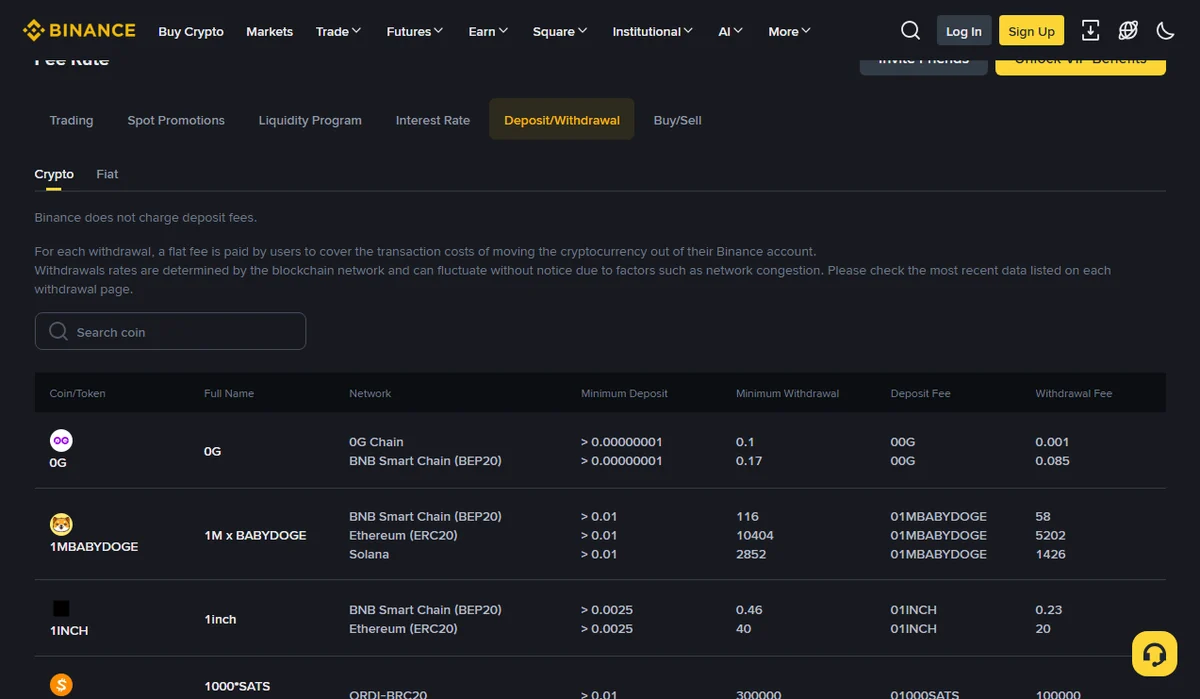
When we searched for USDT there on 11 October 2026, the minimum deposit read “> 0.01” on Tron (TRC20) and BNB Smart Chain (BEP20), and “> 0.001” on Ethereum (ERC20). Kraken’s table on the same day asked for 2 USDT on Tron, 2.5 USDT on Ethereum and 0.4 USDT on Solana. So for the same coin, the threshold ran anywhere from under 0.01 to 2.5 USDT depending on platform and network. Platforms adjust these figures without notice; go by what the receiving platform’s page shows on the day you send.
With a spread like that there is no rule of thumb: change the receiving platform or the network and you have to look again. Don’t skip the “>” on Binance’s table either. Read literally it means “more than”, and the page doesn’t say whether exactly 0.01 is enough — so leave some headroom.
How much to send as a test: work back from what arrives
Kraken’s warning contains the detail that matters most: the amount has to meet the minimum after network fees. If the sending platform takes its withdrawal fee out of the amount you enter, only the remainder reaches the address.
- Receiver’s minimum depositExample: 2 USDT
- Add the sender’s withdrawal feeExample: 1 USDT, taken from the amount
- Add a marginEnter clearly more than 3 USDT
With those numbers, entering 2.5 USDT looks safe because it is above 2, yet only 1.5 arrives — under the minimum. If the fee is charged on top instead of deducted, the amount you enter and the amount received are the same. How to tell the two apart: How to compare USDT transfer fees when the amount is small.
Whether a test is worth doing at all, and what it protects against compared with a withdrawal whitelist, is covered in Withdrawal whitelist or small test: what does each protect? The point here is narrower: a test transfer is a real deposit, so the minimum applies to it as well. The pre-transfer checklist keeps network, address, memo and minimum in one place.
Pages used, opened on 11 October 2026: Binance Help Center “Frequently Asked Questions on Incorrect Deposits” (updated 2025-12-04), “Why Hasn’t My Deposit Been Credited?” (updated 2025-12-19) and the deposit and withdrawal fee page; Kraken Support “Cryptocurrency deposit fees and minimums” (updated 2026-09-03); Bybit Help Center “FAQ — On-Chain Crypto Deposits” (updated 2026-08-14). Minimum deposits change by platform and network; the figures above are what those pages showed that day.