An address book makes destinations easier to select. A withdrawal whitelist restricts which destinations can be used when enabled. A small test checks whether a particular transfer path credits as expected. None of these proves the recipient is trustworthy.
Check the switch as well as the saved entry
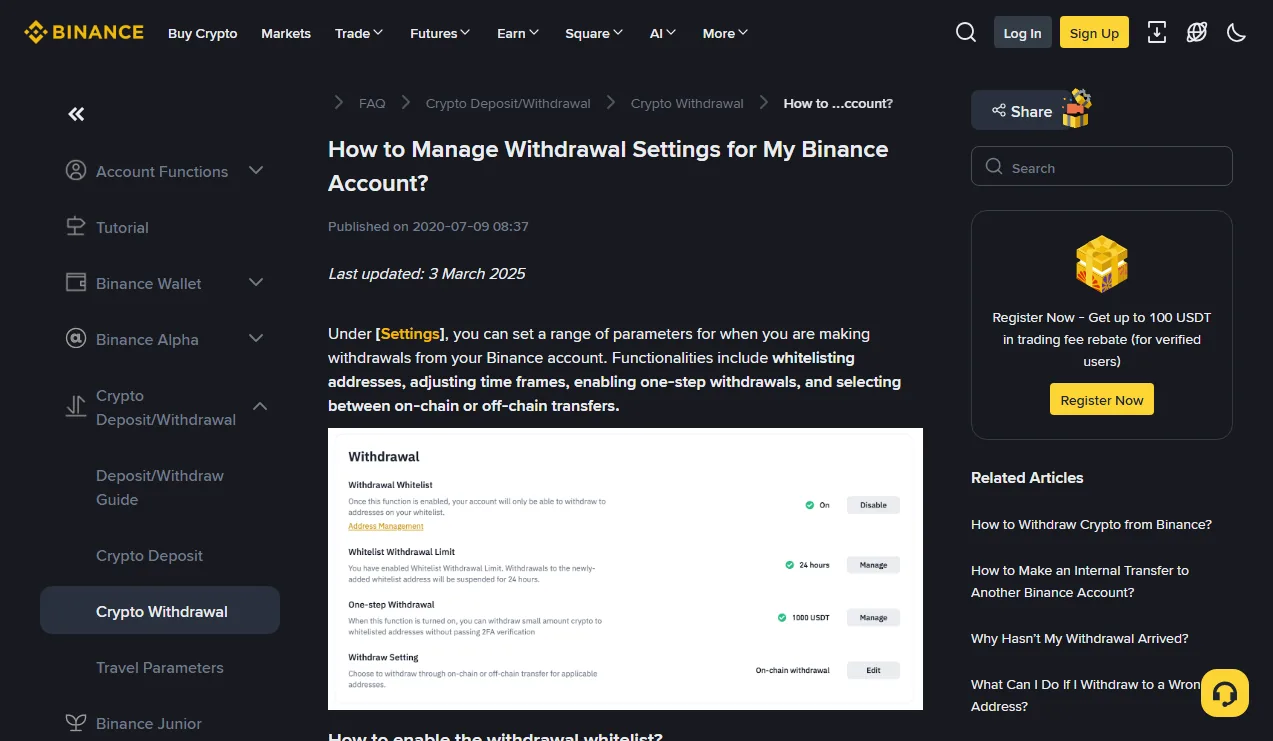
Binance's withdrawal-settings guide separates address management, whitelisting, waiting restrictions and one-step withdrawal. Enabling one does not enable every other protection.
Confirm that the whitelist is on and that the intended address is included. Read any new-address waiting condition and its effective time. Learn these settings before an urgent payment, when a delay is less likely to tempt you to disable a protection you do not understand.
The item worth thinking about on its own is the switch that skips part of the verification. It makes withdrawals to familiar addresses smoother, and the price is one fewer moment where you are made to stop. If the account is yours alone and the destinations are stable, that trade can be reasonable. If your devices or sign-in methods have behaved oddly recently, leave it off: convenience and protection pull against each other here.
Check a new entry before saving it
- Open the current receiving page and confirm the asset and network.
- Copy the full address and required memo or tag.
- Compare the complete pasted address, not just its ends.
- Choose a descriptive name that includes the purpose or network.
- Select the saved entry in the actual sending form and inspect what it fills in.
A nickname does not send a memo. A format check does not prove ownership. If the wrong destination is saved, a whitelist can preserve that mistake. Verify sudden address changes through an established communication channel.
A test succeeds at the receiving end
Use the same asset, network, address and memo planned for the main transfer. Confirm credit in the correct receiving account, not just completion at the sender.
For an example only, suppose the receiving minimum is 20 USDT and 1 USDT is deducted on sending. Entering 20 is insufficient; 21 would reach that hypothetical minimum with no other deductions. Read real minimums and charges from both current pages.
Sometimes a test is not worth running.
If the destination is another account you control, the address was used recently and the amount is small, the fixed fee for an extra transfer can outweigh the risk it removes. Sending to someone for the first time, using a new network, or moving an amount that matters to you points the other way. The deciding question is not the size of the number. It is how much effort you would spend chasing this transfer if it did not arrive.
Testing and the main payment may each be charged. Compare the total using the small-transfer fee method; do not increase an unplanned exposure merely to make the percentage look smaller.
What makes an earlier test insufficient?
A changed network, destination or memo needs a fresh check. Maintenance, a discontinued deposit route or a new minimum can also affect an unchanged address. Yesterday's receipt proves what happened yesterday.
The person messaging you can change even when the address does not. A compromised contact may use a small successful payment to build trust. Credit proves receipt, not the truth of a business promise.
Changes on the platform side count too: a deposit network paused, an address scheme upgraded, an account asked for extra documents. None of that reaches your address book on its own. Reread the current conditions on the receiving page before each transfer instead of trusting an entry saved six months ago.
Keep useful records without mixing in secrets
Record purpose, asset, network, address and memo requirement. Avoid naming every entry “My wallet.” Do not include passwords, authenticator setup keys or seed phrases in address notes.
When a recipient updates an address, verify the replacement and retire the old entry through the platform's supported process. Preserve history separately if needed for accounting. If access to the account may be compromised, investigate sessions and use official support; a whitelist switch alone is not a complete response.
The checklist helps track what you have checked. It does not verify address ownership. For the complete order of operations, read your first USDT transfer.