The FBI's Internet Crime Complaint Center (IC3) said in 2023 that private recovery companies cannot issue seizure orders to recover cryptocurrency, and that law enforcement does not charge victims for investigating crimes. Binance's help center says it cannot freeze a user's assets without an official freezing order from law enforcement or a court. Police and courts can make an exchange act. A paid "recovery team" cannot.
Hold the offers that follow a USDT scam up against those two statements and most of them fall apart. One may arrive as a DM, a friend request in a Telegram group or a reply under your post, from someone who says they are a blockchain tracing team, a law firm, or an exchange security department and can get the money back. What comes next is nearly always a request — a "processing fee", a "retainer", or your wallet's seed phrase.
- "We can freeze that wallet"
- Binance says it can't freeze assets without an official order from police or a court
- "There's a fee first"
- Law enforcement doesn't charge victims; the FTC says legitimate organizations won't charge to recover a refund
- "We're official partners"
- IC3: no law firm is an officially authorized partner of US government agencies
However much they know about your loss, none of these three facts changes.
Why a stranger knows exactly how much you lost
The FTC's page on refund and recovery scams explains it plainly: scammers buy and sell lists of people who have already paid scammers, including names, contact details, the kind of scam and the amount lost. A caller quoting your loss to the dollar hasn't necessarily traced anything on-chain. Your details may simply have been resold.
IC3's August 2025 alert on fictitious law firms (I-081325-PSA) adds the details that show up in practice:
- real lawyers' and firms' names, backed by forged documents and insignia;
- claimed ties to US or foreign agencies, or to bodies that don't exist, such as an "International Financial Trading Commission (INTFTC)";
- a story that you appear on a government list of victims eligible for recovery;
- WhatsApp groups where a supposed attorney and a supposed banker take turns, then point you to a fake foreign bank website;
- payment demanded in crypto or prepaid gift cards, and no willingness to show credentials or join a video call.
Do you have to pay to recover stolen crypto?
No — and that answer alone screens out most offers. The FTC lists the names upfront charges go by: retainer fee, processing fee, administrative charge, tax. IC3's 2023 alert describes what follows payment: the company stops responding, or hands over an incomplete, inaccurate report and asks for more.
Two requests deserve even more suspicion than a fee:
- Your seed phrase or private key. It may be framed as "proving ownership" or "receiving the recovered funds". Whoever holds that phrase can empty what's left in the wallet, so this step turns one loss into two. Receiving crypto only ever takes an address.
- A login to a site showing your "recovered balance". The balance sits there, waiting, until you pay a release fee or a tax. It is a number on a web page.
If part of you still wants to believe them, ask one question: which court or police agency issued the freezing order, and what is the case number? Then look up that agency's contact details yourself rather than using any phone number or link the caller provides.
Someone claims to be Binance support? Check them on Binance Verify
Binance runs a public lookup page, Binance Verify, that works without logging in. Pick a type from the dropdown — website, email, phone number, Telegram or social media account — paste the contact into the search field and press Search.
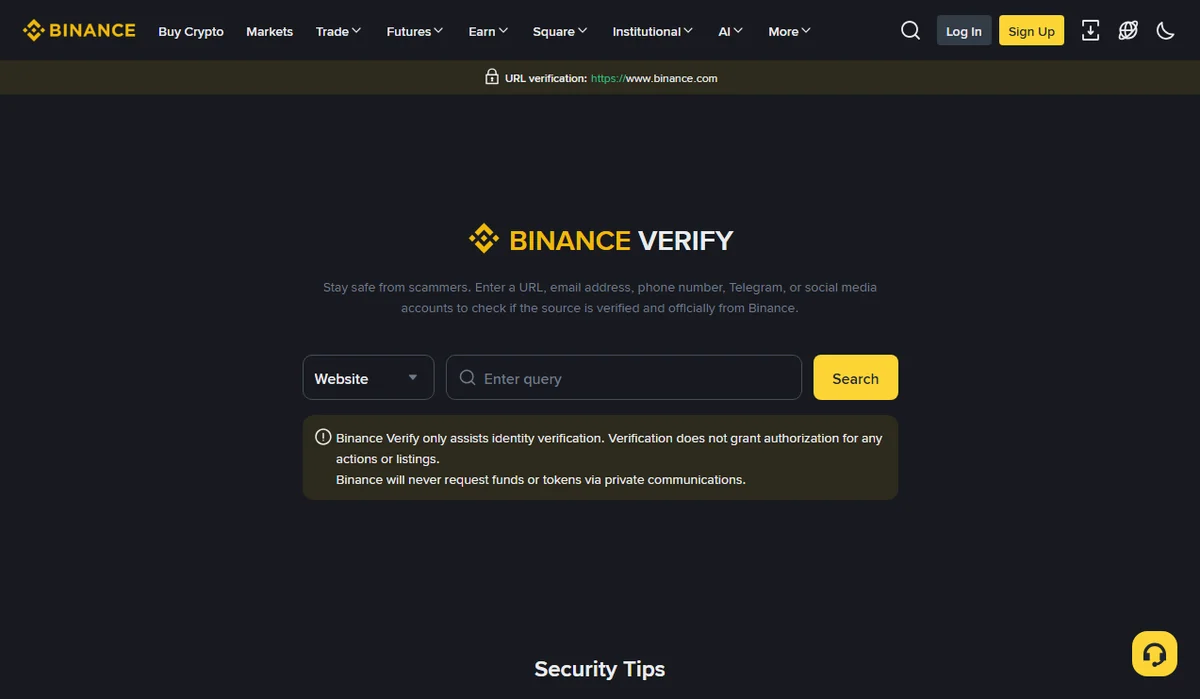
A "no result" means the contact isn't an official Binance channel. A match only confirms identity; the page itself says verification doesn't authorize any action. Either way, a private message asking you to send funds can be handled on the strength of that one sentence in the notice.
For email there is a second check: once you set an anti-phishing code, genuine Binance emails carry it. Setup, and the cases the code won't catch, are covered in Binance anti-phishing code: setup, message checks and what to do after a click.
Stolen USDT went to an exchange: the official route
If the on-chain trail shows your funds landing at an exchange deposit address, the next steps are fixed and need no intermediary. Binance's "How to Report Stolen Funds Transferred to Binance" asks for:
- a detailed account of how and when it happened;
- screenshots or a video of you logging in to the compromised wallet or account, to show you own it;
- which wallet was compromised and which account received the funds;
- every blockchain transaction involved, with clickable TxID links;
- a copy of your police report.
The same page makes obtaining a freezing order the victim's job — report to local police promptly and ask for one — and states Binance isn't responsible for the loss. The exchange can receive evidence and respond to law enforcement. It won't reverse a transfer because of a support ticket.
Finding the TxID and the receiving address in a block explorer is walked through in USDT not received? Check the sender, blockchain and deposit record. If nobody scammed you and you simply sent on the wrong network, the path is different: see Sent crypto on the wrong network? Check status and address control first.
In the US, IC3's alerts point to ic3.gov and your local FBI field office. Elsewhere, start with local police. IC3's 2025 alert also recommends documenting every interaction with the caller, video calls included.
If you already paid a "recovery fee" or shared your seed phrase
Stop paying. "Just one last fee" is the pattern IC3 describes.
If the seed phrase or private key has left your hands, treat that wallet as compromised. Move whatever remains to a newly created wallet, write the new phrase on paper only, and match the network before sending — the pre-transfer checklist covers the details.
The payments to the fake recovery service also have TxIDs and destination addresses. Add them to the same report as the original theft; recovery scams are fraud in their own right, and both the FTC and IC3 take reports on them.
Sources, opened and checked in October 2026: FBI IC3, "Increase in Companies Falsely Claiming an Ability to Recover Funds Lost in Cryptocurrency Investment Scams" (11 Aug 2023) and "Fictitious Law Firms Targeting Cryptocurrency Scam Victims…" (13 Aug 2025); FTC, "Refund and Recovery Scams"; Binance, "How to Report Stolen Funds Transferred to Binance" and Binance Verify.