Stop additional transfers. Find out whether the transaction was sent and who controls the destination address. Those two facts determine whether to contact the sender, receiving platform or your wallet provider. A promise of guaranteed recovery cannot replace them.
If it is still processing, check cancellation options
Look for an official cancellation option and tell the sender which network was chosen incorrectly. A “processing” label does not guarantee that cancellation remains possible, and an empty explorer result does not prove the transaction is unbroadcast.
If a hash exists, look it up on the actual sending network and verify the destination, token and amount. A confirmed transfer generally cannot simply be recalled. Recovery may mean the destination controller sends funds back or a platform allocates a deposit; it does not erase the original transaction. If status is unclear, start with the missing-transfer checks.
Separate the intended route from the actual route
If the receiving page requested Ethereum but the outgoing record says BNB Smart Chain, the networks differ. If the network and address match but a memo is missing, investigate the memo process. A different destination address raises another question about the recipient or copying source.
Keep the original record. Replacing the actual network with the one you meant to use in your support form sends the investigation to the wrong explorer.
Who controls the receiving address?
An exchange or custodial platform
Ask that recipient through official support whether it can handle the actual asset and network. You do not hold its deposit-address key, so changing networks in your own wallet cannot make it credit funds. For your own Binance deposit, read the recovery scope. It is not a general remedy for every withdrawal sent elsewhere.
Your own self-custody address
The asset may exist on the actual network without being displayed by the wallet. Inspect the chain first and consult the wallet's official support for that network and token. Switching the display does not bridge assets. The same address string does not guarantee a universal recovery method: key-controlled and contract accounts have different control models.
Another person's address
Contact the intended recipient through the channel you already trust. Explain the actual network and ask them to check. A balance screenshot or public transaction hash does not prove someone controls an address or will return funds. If the destination itself was wrong, preserve the original instructions and inspect the copy source and saved address.
What does “I have this address” mean?
A deposit address assigned to your account does not give you its private key.
Adding an address for viewing in a wallet also does not give spending control. Identify who can authorize a transfer from that address and whether they support the received asset and network.
A friend's success after switching wallet networks is not evidence that your transfer is recoverable. Custody addresses, ordinary wallets and contract wallets can need different treatment. You do not prove ownership by giving a stranger a recovery phrase.
For your own wallet, start with its existing help. Importing a phrase into an unfamiliar tool creates a much bigger exposure than merely displaying a token.
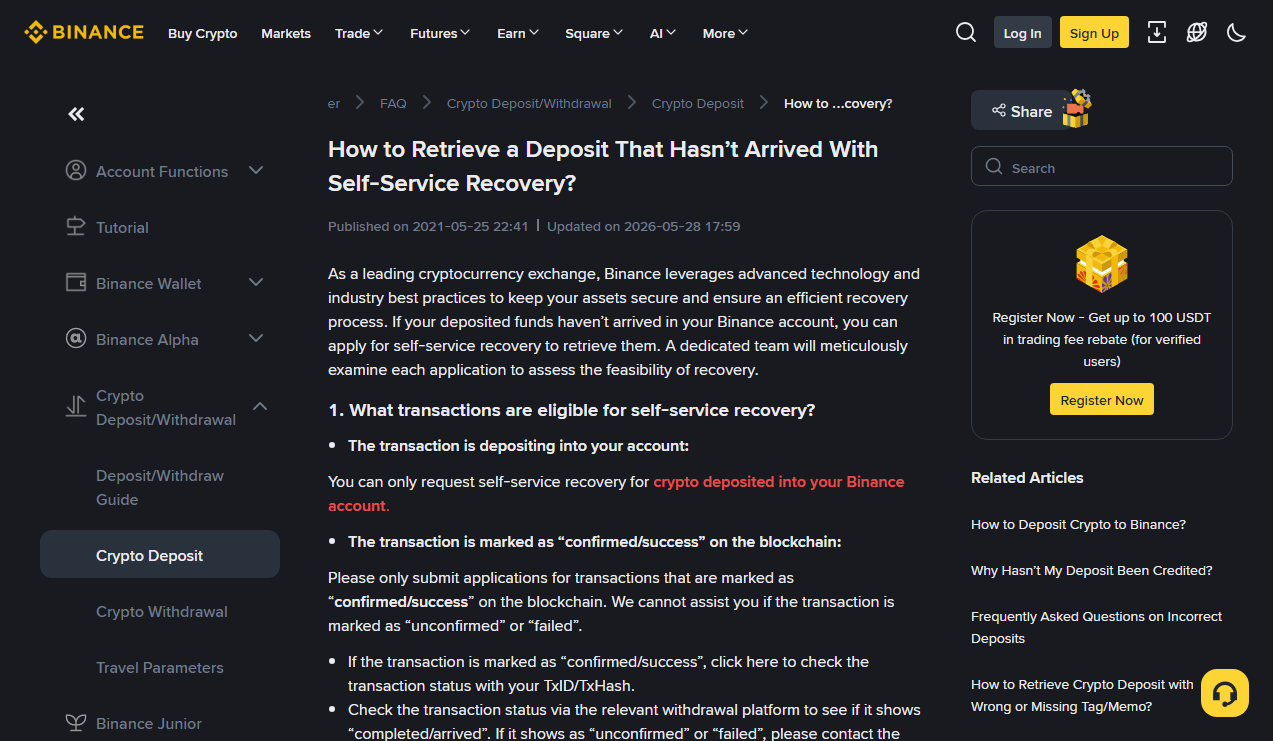
Binance’s self-service deposit recovery requires a deposit into your own account and a confirmed or successful on-chain transaction. Pending or failed records cannot simply enter that process. Tag or memo issues follow separate instructions.
Give support the facts about this transaction
- Actual asset, network, amount and token contract if relevant.
- Full hash and a link to its explorer record.
- Actual destination and memo, plus the network you intended.
- Sending status, internal order reference and time.
- The recipient's deposit conditions or error message.
Leave unknown details marked unknown. Send only what the official process needs, keep the case reference and follow up through the same verified entry. Fee and timing estimates must come from the applicable current recovery process; this site cannot promise them.
Know the proposed result before accepting a charge
Crediting a platform account and returning funds to an external address are different outcomes. Ask which is proposed, what asset and network will be used, where the fee is deducted and whether an unsuccessful attempt is charged. Keep unanswered questions in the official case.
For arithmetic only: if 100 units were sent and an applicable official process explicitly deducts 20 units of the same asset, with no other charges, plan around at most 80 returned units. These are invented teaching amounts, not a recovery fee quote or a promise of success. Charges in different assets cannot simply be subtracted.
A small amount does not make recovery simple. If the recipient confirms that recovery is unsupported, repeated private “assessment” payments do not change control of the address. Keep the reason given and stop adding new spending.
Do not turn a recovery attempt into another transfer
An extra payment will not automatically correct the wrong network. Public blockchain queries do not need your seed phrase or private key. Someone who can quote your public hash has not proved they work for a platform. Do not trust a recovery-fee address sent in a private message just because the sender uses technical terms.
Buying the native fee asset for your own wallet and paying a stranger's “gas address” are different actions. Do not sign unknown permissions, install remote-control software or share recovery material to follow a supposed rescue procedure.
If assistance produces a return, check its new network, destination, memo and actual credit, and reconcile any shortfall with the official fee record. An accepted application is still processing. Keep the original outgoing hash and new return transaction separately; the first is not a refund receipt. Mark the saved address for review and repeat the network-matching checks before sending again.