If the deposit page says a memo is required but the sending form lets you leave it blank, follow the deposit requirement. A form that accepts submission does not prove the receiving platform can identify your account.
One deposit address can serve several accounts
Some platforms use a shared address and an additional identifier to allocate deposits. The XRPL destination-tag documentation explains this use for XRP. Other networks have different formats and rules.
A missing tag can leave a transfer visible on-chain without an account credit; some recipient settings reject untagged payments. Check the actual transaction status before assuming that funds have disappeared.
Copy from A's deposit page
Copy from B's deposit page
Where to copy it and where to paste it
Select the asset and network on the receiving page. If it supplies both an address and a memo or tag, copy each into its corresponding sending field. If no memo appears and the requirement is unclear, check that receiving service's instructions first.
Distinguish the address label from the transaction memo. Calling an address “My account 12345” does not send 12345 as a tag. Copy the value exactly; do not substitute an email, order number or username. Check missing characters, spaces and the result of a QR scan. A QR can contain only the address.
Compare network, address and memo again on the final confirmation. If someone says the memo is unnecessary while their deposit screen requires it, ask them to verify the asset and network rather than ignoring the screen.
Already omitted it or used the wrong value?
Stop additional transfers. A second payment with the right tag does not automatically identify the first. If the sender is still processing, inspect its official cancellation options; changing your address book cannot amend a broadcast transaction.
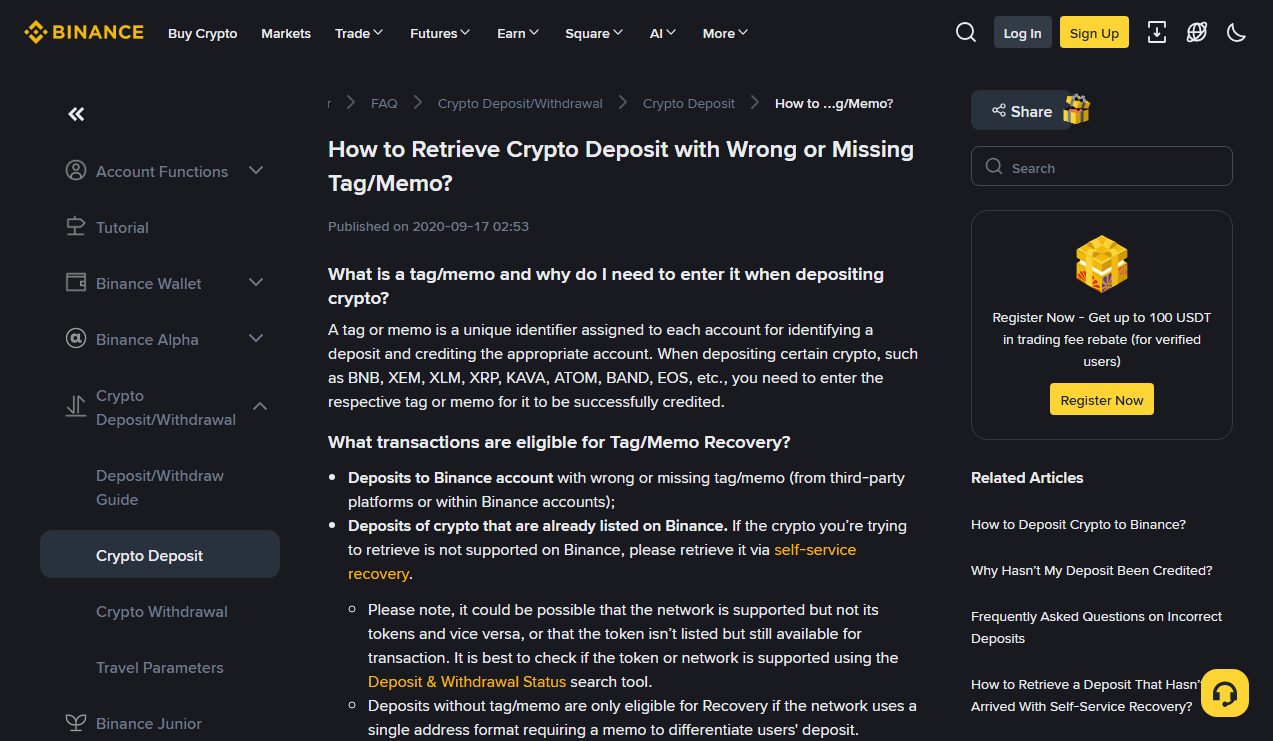
For a Binance deposit, consult the incorrect or missing memo guidance and its eligibility conditions. For another destination, contact that receiving platform. The sender can trace dispatch but cannot assign balances inside another service.
Check the recovery conditions before applying: after fees, the amount must meet the minimum withdrawal. Binance describes a return to the original sending address, so coordinate with the sending platform if necessary. Its guidance says it cannot help when the wrong tag credits another user.
- Keep the asset, network, amount and time.
- Record the full transaction hash and destination.
- Distinguish the memo actually sent from the memo required.
- Provide sending and receiving records as requested through official support.
If you entered another valid tag, report the real value without guessing whose account it belongs to. Recovery, fees and timing are the platform's decision. Never provide seed phrases or private keys to a person offering to “add the memo.”
Check what the saved address actually fills in
After saving an address, select it in the sending form and verify that the memo is in the correct field. A nickname that displays the number may still leave the transfer memo blank.
Reopen the current deposit page next time. Update saved information if the address or memo changes. A test on another network cannot validate this one, and the test itself must meet the minimum and memo requirements. See whitelists and small tests.