Why is there still a withdrawal charge when your account has trading cashback? The benefit may cover trades without covering withdrawals or wallet transactions. Start with the operation that caused the charge.
Record only the operations you actually performed
You might buy an asset, withdraw it to your wallet and later send it onward. Each can generate a separate cost, but doing only one step does not mean you owe all three. An internal transfer between account areas is not automatically an on-chain withdrawal.
Read the fills and fee asset
Read the current confirmation
Read the wallet and chain record
Write down the route you will actually use
Start with what you own, where it will go and whether you will send it again. If you already hold USDT and only withdraw it to the recipient, do not add an imaginary purchase fee. If it will pass through your wallet first, include that second send when comparing routes.
A blockchain explorer and a platform statement describe different records of the same operation. Seeing a fee in both places does not automatically mean you paid twice.
Use the actual fills to check trading fees
Identify the product and applicable account conditions. Binance's fee page is a starting point, not a single rate that applies to everyone.
A limit order can take existing liquidity and incur taker treatment. Read each fill rather than assuming the order name determines the fee. If only four of ten units traded, record the four filled units; reserved balance is not the same as paid fees. The order-types guide explains this distinction.
Keep the fee asset beside its amount. USDT, the traded asset and another fee-payment token cannot be added without conversion. If you convert for accounting, retain the original amount and the price used.
Why can the balance increase be smaller than the fill?
Suppose a hypothetical fill buys 10 tokens and the fee is 0.01 of that token, with no other deductions. The balance increases by 9.99. Do not deduct that 0.01 a second time as a withdrawal fee. If another asset pays the fee, inspect both asset records.
This is a bookkeeping example, not an account fee schedule. The fee asset beside the charge matters more than a change in the fiat value of your portfolio.
Read entered amount, total debit and expected receipt
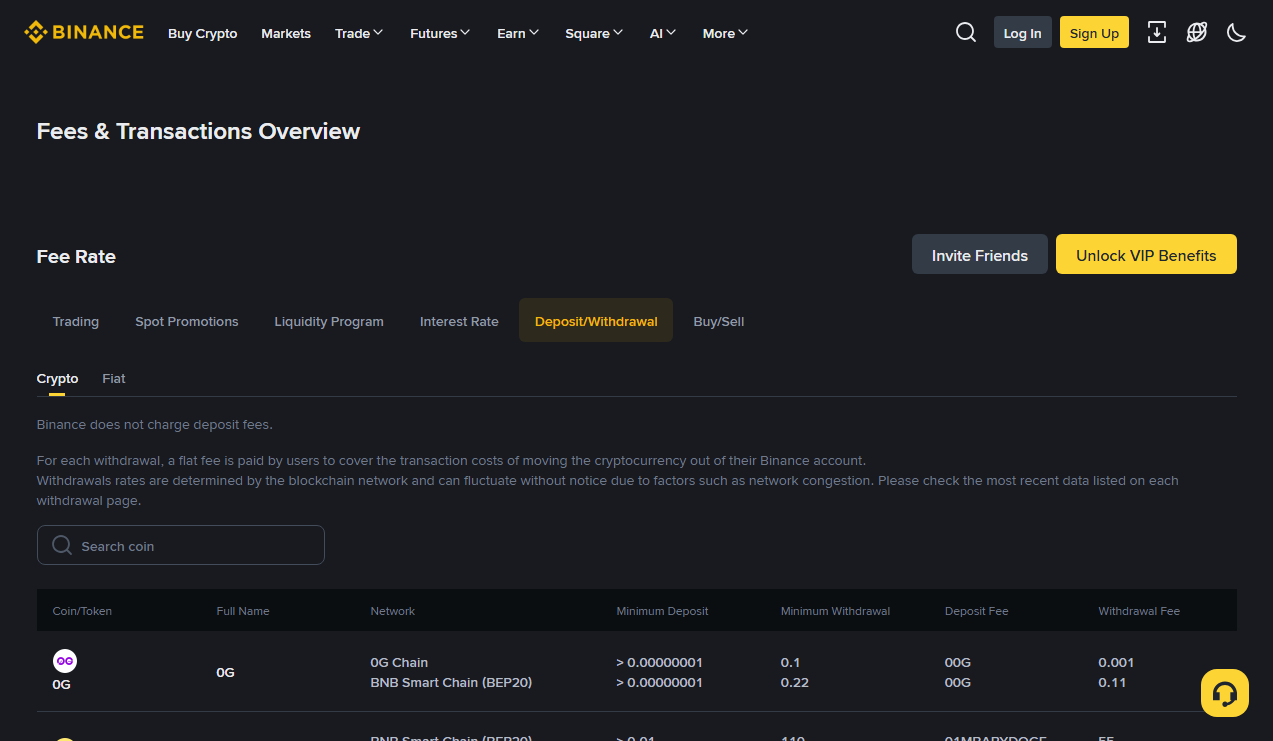
Withdrawal charges can change with network conditions; Binance's withdrawal-fee explanation directs readers to current withdrawal information. An old fee screenshot is not today's quote.
Change the network and the quote often moves by an order of magnitude; the same network can cost more while it is busy. There is no permanently cheapest chain to copy down here. Saving anything means listing the quote and the expected receipt for every available network at the moment you confirm. Small amounts deserve that half minute most, because a fixed fee does not shrink with the transfer and its share grows instead.
In an example with 100 USDT entered and a fixed 1 deducted, 99 arrives. If the fee is additional, both the receipt and total debit differ. Check the receiving minimum against the actual net amount.
Do not paste another website's gas estimate on top of the platform's quote. Count an additional wallet fee only when another operation actually requires it. A transaction's explorer fee also need not equal the service charge shown to an exchange customer.
Is receiving free? Look at which side starts the transfer
The answer depends on who sends.
When you move an asset in from another platform or wallet, the sending side charges: a withdrawal fee under its own rules, or a network fee you pay from a wallet. The receiving side usually does not charge again for funds arriving, but it can set a minimum deposit, accept only certain networks, or require a memo. Miss one of those and the transfer may simply not be credited. “Free deposits” and “this transfer costs nothing” are separate claims.
Buying with local currency works differently. The cost usually sits inside the channel: payment methods carry their own service charge, and the quote itself may already include a spread. Separate the service charge from the spread before comparing that route with an on-chain transfer.
The one most often missed is a transfer between accounts on the same platform. An internal move generally never touches a chain, so there is no network fee, but it also does not mean the asset has left for the chain. Establish which route a transfer actually took before looking for its cost.
Before you act, the receiving page really only asks four things: which networks it accepts, which address belongs to the network you picked, whether a memo is required, and the minimum that will be credited. Comparing quotes only means something once all four line up. Read them again each time, because addresses change, networks pause and minimums are adjusted.
An estimate, a maximum and a paid fee are not identical
This charge is not the one the platform collects.
Ethereum gas measures computational work and is ordinarily paid in ETH; a token balance alone does not supply it. See the official gas documentation. Different operations can consume different amounts.
Before submission, read the estimate. After completion, record the actual cost rather than treating the displayed maximum as money already spent. Where a wallet offers sponsored or alternative-asset fee payment, check the asset charged, provider and any extra cost instead of applying ordinary-wallet assumptions.
Looking up a public balance in an explorer does not require paying anyone gas. Before approving a wallet request, identify the operation it would perform. An approval and a token transfer may be separate transactions; one confirmation screen may not cover the whole route.
If an attempt fails, keep its actual fee record too. Counting only the successful retry can understate what you spent.
One way of getting stuck surprises almost everyone the first time: the USDT is sitting right there, but the wallet reports an insufficient balance. What is missing is not USDT. It is the native coin that pays for fees on that chain. Add the asset the wallet asks for, or use a network where you already hold a fee balance, rather than raising the fee and retrying, because each attempt can cost real money.
When can cashback count as a saving?
First confirm account eligibility, covered products and settlement terms. A fee charged now and a later rebate may appear in separate records. An uncredited benefit is not spendable balance, and trading cashback does not automatically pay withdrawal charges or supply wallet gas.
Vouchers can have expiry and use restrictions. Do not simply add every item labelled a promotion. Registration questions belong in the referral guide; existing users should inspect their own benefit records.
A small record that prevents double counting
| Record | Keep | Avoid counting |
|---|---|---|
| Trade fills | Quantity, price, fee asset and fee amount | Unfilled quantity as completed spending |
| Withdrawal result | Entered amount, total debited and receipt | The same network charge again from an explorer |
| Wallet send | Sent asset and actual network cost | A maximum estimate as a paid amount |
| Rebate record | Asset and amount actually received | A benefit that has not arrived |
You do not need elaborate accounting software to investigate one transfer. Keep the original amounts and units so every charge points to an operation. Convert to one unit only when comparing; overwriting the originals makes later exchange-rate differences harder to explain.
If the balance difference still does not reconcile
Separate paid fees from open-order reservations and balances in other account areas. Quote differences can also reflect spread, price changes or execution, not just an explicit fee. Match quantities, times and units before comparing.
Ask support which recorded operation caused a particular charge, supplying the fee asset and relevant fill. To compare outgoing quotes, use the calculator; for a fixed receiving target, read working backwards from the amount needed.